

A lot of everyday expenses have gotten cheaper over time, but many people still overpay out of habit.
Here are 20 things that used to be expensive but are now much more affordable if you know where to look.
1. Car insurance
I didn’t realize how much I was overpaying for car insurance. I had a clean record, no tickets, and figured my rate was probably fine. It wasn’t.
When I compared my options with a free tool, I found offers way lower than expected. I switched and saved about $1,300/year for the same exact coverage.
Here’s how to check:
Enter your zip code
Answer a few questions about your car
Compare offers and pick the one that makes sense
It’s free, takes about 2 minutes to start, and you don’t have to switch if you don't find savings.
Enter your zip code here and see if you could save
2. Ad blockers
If you’re still browsing the internet without an ad blocker, you’re working way harder than you need to.
A good ad blocker quietly removes most of the junk you deal with every day - banner ads, pop-ups, autoplay videos, and those endless YouTube interruptions that somehow always hit at the worst moment.
Once it’s installed, it just runs in the background. Pages load faster, sites feel cleaner, and you’re not constantly being tracked by random ad pixels following you around the internet.
Most people I know use something like Total Adblock. It’s cheap, takes about a minute to set up, and you immediately forget it’s there - except everything suddenly works better.
If you spend any real amount of time online, this is one of those “why didn’t I do this sooner” fixes.
Get Total Adblock here
3. Financial advisors
A lot of people try to manage their money completely on their own - and honestly, it’s one of the biggest financial blind spots out there.
Sure, you can DIY your investments, retirement plan, tax moves, and long-term strategy. But most people don’t have the time, tools, or interest to stay on top of everything. A good advisor isn’t just someone who picks funds - they’re someone who keeps an eye on your entire financial picture so you don’t have to.
Research backs this up, too. Vanguard found that working with a financial advisor can add around 3% net in extra returns per year¹. Over decades, that’s the difference between “comfortable” and “wow, I actually did pretty well.”
More importantly, advisors take care of the complicated stuff you’d never think about:
Making sure your retirement plan actually works
Handling weird tax implications before they become problems
Keeping your investments balanced instead of emotional
Helping you set up insurance, estate plans, and income strategies that fit together
If you don’t already know a trustworthy advisor, Datalign makes the search part easy. You answer a few quick questions, and they match you with vetted financial advisors in your area who fit your goals and comfort level.
If you want the simplest way to get expert guidance without hunting around, start with the match quiz and see who they recommend.
Find your advisor match on Datalign
4. Use this before you buy anything online
You might be surprised how often you’re overpaying on Amazon and elsewhere.
Big stores like Amazon know that no one has time to price shop through dozens of sites, so there’s often no incentive for them to offer bargain prices.
I typically hate browser extensions with a fiery passion, but if you donʼt have Capital One Shopping added yet, do yourself a favor and grab it.
When you shop online (on Amazon or elsewhere) it will:
Auto-apply coupon codes to potentially help save you money
Compare prices from other sellers to help you check whether a lower price may be available
Hereʼs a quick example of how it works:
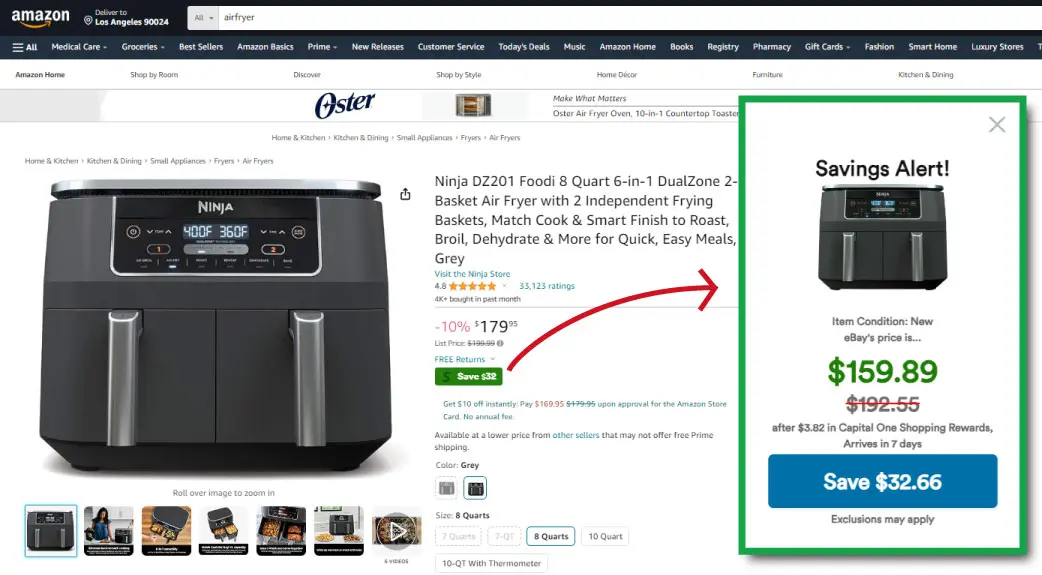
Savings will vary, this is just an example, of course.
Whenever the extension finds an available discount, you’ll see a little savings alert pop-up. For example, here you can save $32 on this air fryer.
Here's a link to Capital One Shopping, if you're interested.
5. Tapping into your home equity
If you own a home, you’ve probably looked at your equity and thought, “There has to be a smarter way to use this.” Especially when big expenses pop up - the remodel you’ve been putting off, high-interest credit card balances, or just general life stuff that isn’t cheap.
But with today’s interest rates, refinancing or taking out a big lump-sum loan isn’t always the smartest move anymore.
Here’s an option a lot of homeowners are leaning toward instead: a home equity line of credit (HELOC).
A HELOC works more like a credit card tied to your home’s value. You tap into it only when you need funds, and during the “draw period” (usually 10 years), you’re just making minimum payments. After that, you pay back what you used over a longer repayment period.
It’s flexible, it’s there when you need it, and you’re not stuck paying interest on a giant loan you didn’t fully use.
Rates are usually variable too - so if the market cools down, you’re not locked into something sky-high forever.
If you’re curious what kind of offer you could get, tools like LendingTree’s matching tool make the comparison part easy. You answer a few questions, they show you your options, and you can decide whether a HELOC makes sense for whatever big expense you’re trying to tackle.
It’s one way to access your home’s value without overcommitting to a loan you don’t actually need.
Compare offers from lenders here.
6. Luxury hearing aids

Top-notch hearing aids used to cost up to $8,000 a pair, sometimes more.
But the industry has changed dramatically. You can often get access to trials of high-end hearing aids (like Horizon IX from Hear.com) for dramatically less than $8k/pair.
Horizon IX hearing aids have gotten wildly popular this year: largely because of their ability to separate voices from background noise.
They're ultra small, and use German-made "dual-processing" technology that makes speech sound louder, and unnecessary noises sound softer. Some 670,000 customers have already switched to Horizon since their launch.
If you're interested, check here to see if you can get into one of their 45-day trials.
7. Home insurance (save up to $1,000/year)
If you’re looking for better home insurance, whether that means lower rates or better coverage, there’s one thing you have to do: compare quotes from multiple providers.
A lot of people miss this step. But getting multiple options could save you thousands over the years you own your home. And yes – you can switch your insurance any time.
This site makes the comparison part easy. They match you with a range of home insurance offers based on your needs and budget, so you can choose the right fit without spending hours searching.
Just answer a few quick questions to get started. And if an agent reaches out, don’t ignore it, they’re there to help you lock in the best possible rate.
Enter your zip code to see your options
8. Credit card debt
When you’re deep in debt, it can feel overwhelming. Like no matter what you do, you’re just treading water. And the longer it goes on, the harder it is to catch up.
That’s where National Debt Relief might be able to step in. If you owe more than $10,000 in credit card debt, medical bills, personal loans, or collections, they could help you combine it into one lower monthly payment.
There are no upfront fees, and many people become debt-free in 12 to 48 months. Getting started takes about 30 seconds – just answer a few quick questions to see if you qualify.
See if you qualify with National Debt Relief
9. Subscriptions
Free trials are sneaky. You sign up, mean to cancel, and then months later you’re still paying for something you haven’t opened once.
That’s where a subscription tracker actually helps. Rocket Money is one I’ve used, and it’s straightforward.
Once you connect your accounts, it pulls together a list of recurring charges (streaming services, apps, memberships) all in one place. From there, you can decide what’s worth keeping and what’s just quietly draining money.
If you want, they also offer a premium option where they’ll handle the cancellations for you. Totally optional, but useful if you hate dealing with customer support loops.
It takes a couple of minutes to set up, and even cancelling one forgotten subscription can make it worth the effort.
The free version alone is enough to see where your money’s actually going.
10. Earn A $200 Bonus And Pay No Interest Until 2028
You could be paying $0 in interest on your credit card until nearly 2028. Some of the best 0% intro APR cards right now also come with a huge bonus, up to 5% cash back on everyday spending, and no annual fee — and our experts just picked the top ones worth checking out.
If you're still paying interest every month, this is your sign. Click here to see which cards made the cut.